en
en v
Phone
Cart0 Tickets
Total: 0€
Account
Calendar
Search
Menu
X

Woolf Works Ballet

VenueVienna State Opera
CalendarTue 20 Apr 2027 - Wed 16 Jun 2027
Synopsis/Details


Woolf Works – Wayne McGregor | Ballet


About the production

A triptych of ballets drawn from Virginia Woolf’s landmark novels Mrs Dalloway, Orlando, and The Waves with elements of her letters, essays and diaries, Woolf Works explores the collision of form and substance in Woolf’s writings – a recreation of the vivid, impressionistic qualities of Woolf’s prose, where emotions and sensations take precedence over plot. 


Woolf Works expresses the heart of an artistic life driven to discover a freer, uniquely modern realism, and brings to life Woolf's world of 'granite and rainbow' where human beings are at once both physical body and uncontained essence.

The work sees Wayne McGregor reunited with acclaimed British composer Max Richter who creates a specially commissioned score incorporating electronic and live music, with set designs by architectural practices Ciguë and We Not I alongside costume and lighting designs by long-time collaborators Moritz Junge and Lucy Carter.

A work commissioned by the Royal Ballet London.


Total duration – approx. 95 minutes


About the choreography

Woolf Works marks a turning point in narrative classical ballet. The work has brought the genre of story ballet into the 21st century by combining powerful choreography with innovative technology.

Woolf Works is structured into three acts; ‘I now, I then’, ‘Becomings’ and ‘Tuesday’, each starkly distinct in visual design and choreography. “Woolf Works is not a literal description of Woolf’s writing. It’s very lavish, with new visualisation techniques and a collage structure; a full-on assault and collision of the senses. I think it’s interesting to have choreographed and designed the piece in the spirit of Woolf’s writing, in an unfolding stream of consciousness, rather than as a literal translation of the novels narratives” (Wayne McGregor)


Nice to know

Woolf Works premiered in 2015 with The Royal Ballet. Wayne McGregor created the role of Virginia Woolf for ballet director Alessandra Ferri, who was awarded a Laurence Olivier Award for her interpretation.

  • ⌖  Arrival Information
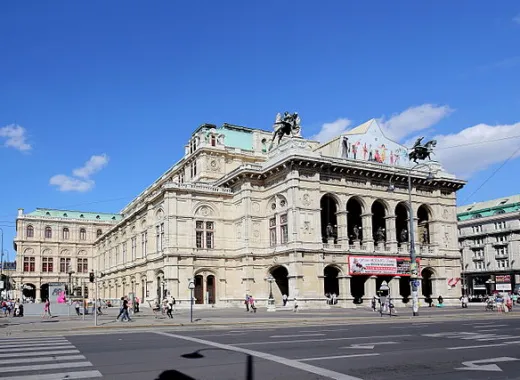
    •    The Vienna State Opera is located at Opernring 2, 1010 Vienna, and is easily accessible by public transport, bicycle, taxi or car.
       
    • › Public Transport – Metro U1, U2, U4 (Karlsplatz); Tram 1, 2, D, 71 (Oper, Karlsplatz); Bus 59A; Badner Bahn (Vienna Opera Station).
    • › By Bicycle – Bicycle stands are available on both sides of the Opera House.
    • › By Taxi – Taxi stands are located nearby, with taxis available at the main entrance after performances.
    • › By Car & Parking – Several parking garages are within walking distance: Operngarage (Herbert-von-Karajan-Platz, approx. 150 m); Kärntnerringgarage (Mahlerstraße 8, approx. 200 m); Opernringhof (Elisabethstraße 2, approx. 150 m).
  • ✧  Dress Code

    • › Dress Code: Guests are encouraged to dress elegantly for their visit. Flip-flops, undershirts worn as tops and very short shorts are not permitted. Head coverings that obstruct other guests' views are also prohibited.
  • ◷  Duration Details
    • › Duration – The start and end times are indicated for each performance date. Further details about the duration, acts and intermissions can be found on the individual performance pages, where available. Please note that performance information may be subject to change
    • › Admission – We ask you to arrive punctually for the performances. Late arrivals can only be admitted during the intermission. It is not possible to be admitted after intermission-during the performance.
  • ⎔  Accessibility
    • › Accessibility –  Due to its historic structure, the Vienna State Opera has limited accessibility. However, facilities are available to make visits as comfortable as possible for visitors with reduced mobility. All seating areas are accessible by elevator, and wheelchair-accessible toilets are available on both levels.
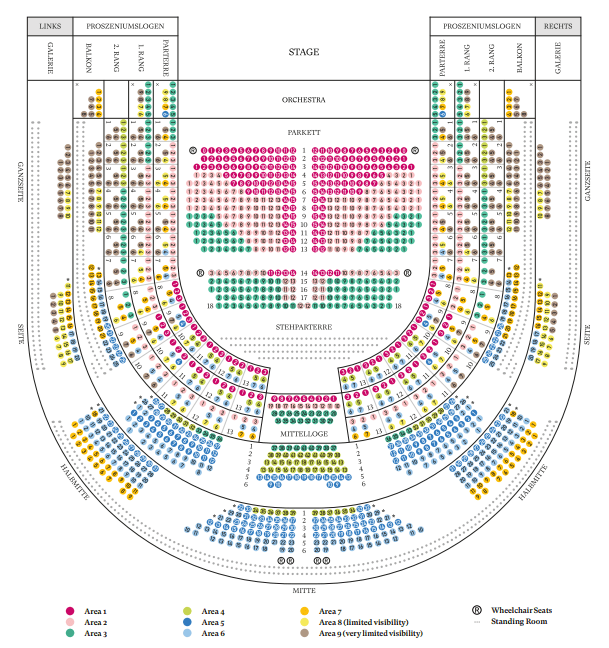
    • › Wheelchair Spaces – The opera house offers 22 wheelchair spaces: four in the stalls and 18 in the gallery (subject to availability).
    • › Access – The step-free entrance is located on the Herbert-von-Karajan-Platz side, at the beginning of the arcades (87 cm wide). The stalls and gallery elevator can be reached via the inclined lift in the opera foyer, near the Opera Café. The gallery elevator measures 95 × 140 cm, with an 80 cm door clearance. Checkrooms, interval buffets and accessible toilets are available on both levels.
  • ☷  Visitor Guidelines
    • › Photography & video – Photography, filming and the use of smartphones are not permitted during performances. Private photography is allowed during intermissions and curtain calls. Smartphones and cameras are strictly prohibited in the proscenium boxes throughout the performance.
    • › Cell phones – Please switch off your mobile phone or activate flight mode and keep it stored away during the performance to avoid disturbing performers and other visitors.
    • › Cloakroom – Coats, jackets and bulky items such as bags or backpacks must be left in the free cloakrooms located near the entrances, on both sides of the balcony and in the gallery. Box guests can use the cloakroom in their box.
Cast

Musical Direction: Paul Connelly
Concept, Staging & Choreography: Wayne McGregor
Music: Max Richter
Set Design: Ciguë, We Not I, Wayne McGregor


Costumes: Moritz Junge
Lighting: Lucy Carter
Film Design: Ravi Deepres
Dramaturgy: Uzma Hameed
Make-up Designer: Kabuki
Sound Associate: Chris Ekers

Venue
Vienna State Opera

Public Transport

Subway lines: U1, U2, U4
Trams: 1, 2, D, J, 62, 65
Buses: 59A
Local Railway: Badner Bahn
Stops: Karlsplatz / Opera

Taxi stands are available nearby.
 

Parking

Parking is only € 6, - for eight hours!

The Wiener Staatsoper and the ÖPARK Kärntner Ring Garage on Mahlerstraße 8, under the “Ringstraßengalerien”, offer the patrons of the Vienna State Opera a new, reduced parking fee. You can park in the Kärntner Ring Garage for up to 8 hours and pay only a flat fee of € 6, -. Just validate your ticket at one of the discount machines inside the Wiener Staatsoper. The normal rate will be charged for parking time greater than 8 hours. The validation machines can be found at the following coat checks: Operngasse, Herbert von Karajan-Platz, and the right and left and balcony galleries.

Important: In order to get the discount, please draw a ticket and do not use your credit card when entering the garage!

After devaluing your ticket in the Wiener Staatsoper you can pay comfortably by credit card or cash at the vending machines.

The machines accept coins and bills up to 50.- Euro. Parking time longer than 8 hours will be charged at the normal rate.


History

The structure of the opera house was planned by the Viennese architect August Sicard von Sicardsburg, while the inside was designed by interior decorator Eduard van der Nüll. It was also impacted by other major artists such as Moritz von Schwind, who painted the frescoes in the foyer, and the famous "Zauberflöten" (“Magic Flute”) series of frescoes on the veranda. Neither of the architects survived to see the opening of ‘their’ opera house: the sensitive van der Nüll committed suicide, and his friend Sicardsburg died of a stroke soon afterwards.


On May 25, 1869, the opera house solemnly opened with Mozart's Don Giovanni in the presence of Emperor Franz Joseph and Empress Elisabeth.
The popularity of the building grew under the artistic influence of the first directors: Franz von Dingelstedt, Johann Herbeck, Franz Jauner, and Wilhelm Jahn. The Vienna opera experienced its first high point under the direction of Gustav Mahler. He completely transformed the outdated performance system, increased the precision and timing of the performances, and also utilized the experience of other noteworthy artists, such as Alfred Roller, for the formation of new stage aesthetics.


The years 1938 to 1945 were a dark chapter in the history of the opera house. Under the Nazis, many members of the house were driven out, pursued, and killed, and many works were not allowed to be played.


On March 12, 1945, the opera house was devastated during a bombing, but on May 1, 1945, the “State Opera in the Volksoper” opened with a performance of Mozart's THE MARRIAGE OF FIGARO. On October 6, 1945, the hastily restored “Theaters an der Wien” reopened with Beethoven's FIDELIO. For the next ten years the Vienna State Opera operated in two venues while the true headquarters was being rebuilt at a great expense.


The Secretary of State for Public Works, Julius Raab, announced on May 24, 1945, that reconstruction of the Vienna State Opera would begin immediately. Only the main facade, the grand staircase, and the Schwind Foyer had been spared from the bombs. On November 5, 1955, the Vienna State Opera reopened with a new auditorium and modernized technology. Under the direction of Karl Böhm, Beethoven’s FIDELIO was brilliantly performed, and the opening ceremonies were broadcast by Austrian television. The whole world understood that life was beginning again for this country that had just regained its independence.


Today, the Vienna State Opera is considered one of the most important opera houses in the world; in particular, it is the house with the largest repertoire. It has been under the direction of Dominique Meyer since September 1, 2010.

Hotels and Airbnb's Nearby

Buy now

Gift vouchers for Vienna Theaters

Gift someone an unforgettable night at the opera.
Choose a gift coupon and let them pick the performance they love—music, drama, and world-class artistry, all in one elegant experience.
Official Tickets for Vienna Opera Theater, Concerts, Musicals, etc.
Instagram
Payment
Google Play
App Store
© 2026 RM EUROPA TICKET GmbH
Whatsapp